Parkinson’s Disease
MISBA® platform unlocks important targets with disease-modifying potential
Progressing first-in-class validated targets for a range of large neurodegenerative disorders
Parkinson's disease : Progressive movement disorder effecting 1% of people over the age of 60
Parkinson's disease (PD) is a progressive neurodegenerative disorder characterized primarily by motor symptoms including bradykinesia, resting tremor, rigidity, and postural instability. In addition to motor manifestations, non-motor symptoms such as cognitive impairment, depression, autonomic dysfunction, and sleep disturbances significantly impact quality of life, highlighting the systemic nature of the disorder.
Globally, the number of people living with Parkinson's disease has been rising over recent decades and estimates suggest that Parkinson’s affects more than 6 million people worldwide, making it the second most common neurodegenerative disease after Alzheimer’s disease. Currently there are no disease-modifying therapeutics for PD, only therapies to control the symptoms.
Human genetics and observations in PD post‐mortem brain have indicated that deficits in glucocerebrosidase (GCase protein, encoded by the GBA1 gene) and aberrant lysosomal homeostasis are central to PD pathophysiology. Indeed, mutations in GBA1,are the strongest genetic risk factor for PD and are a determinant of both disease onset and progression. GBA1 mutations are found in 5–15% of patients - giving rise to GBA1-PD.
Harness’ approach to GBA1-PD
GCase is synthesized in the endoplasmic reticulum (ER), where it binds to LIMP2, a lysosomal transport protein encoded by the SCARB2 gene. LIMP2 facilitates the transport of GCase to lysosomes, ensuring GCase gets to the correct compartment while preventing it becoming stuck elsewhere in the cell when GBA1 is mutated.
GCase exists within a bidirectional pathogenic loop with αSyn and increasing GCase activity has been shown to mitigate αSyn-related pathologies. A number of therapeutic approaches based on increasing GCase protein levels by gene therapy and other modalities are being investigated. However, these approaches do not address the transport of the GCase protein into the correct cellular compartment. Critically, GWAS studies have also suggested that variation in SCARB2 could be a factor in PD risk. This together with in vitro studies, suggests that the effectiveness of approaches solely based on delivering additional GCase to the cell (such as GBA gene therapy) could be limited by constraints in GCase transport.
PD therapeutic solution
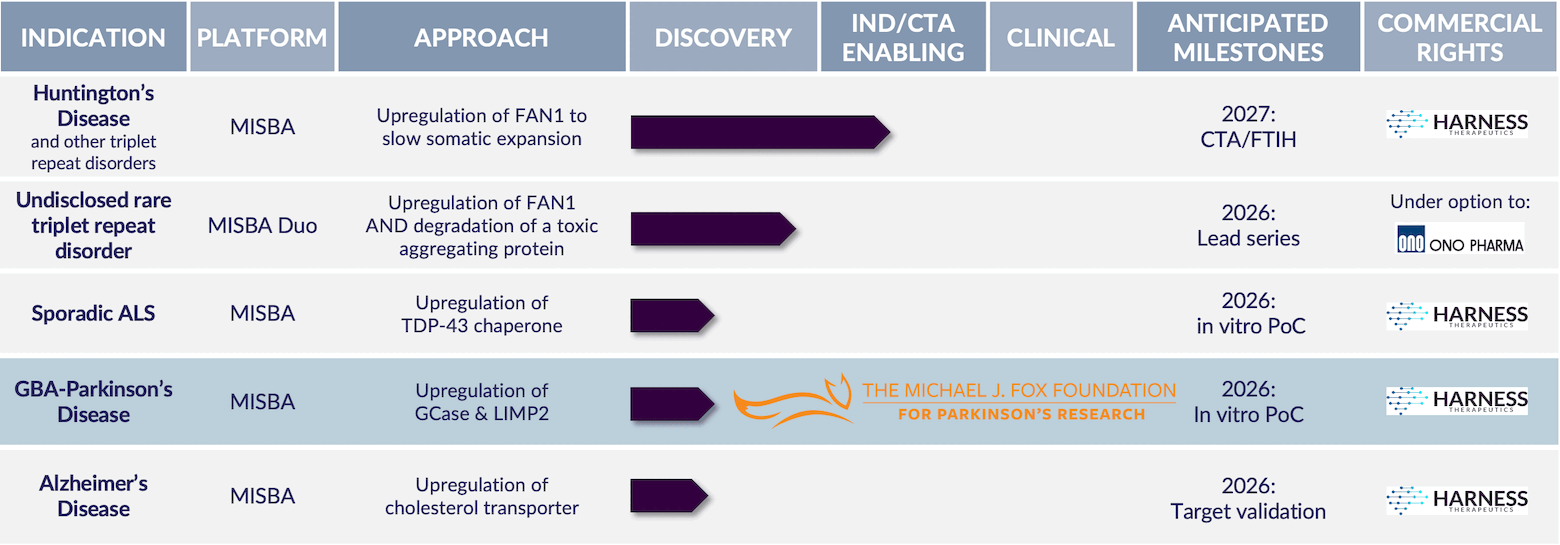
To address this constraint, Harness’ approach is based on simultaneously increasing levels of GCase and its trafficking partner, LIMP2. This approach would enhance GCase activity within the lysosome and counteract GCase deficits, restore lysosomal homeostasis and mitigate αSyn pathology in GBA1-PD.
We believe that this unique approach, enabled by our MISBA® platform offers has exciting potential to deliver a disease-modifying treatment for patients with GBA1-PD and other synucleinopathies.
Beyond GBA1-PD
The role of GCase, extends beyond those patients with GBA1-PD, providing opportunities for indication expansion to other synucleinopathies including:
· Idiopathic PD
· Dementia with Lewy bodies